Why the skills that made you great at work are backfiring at home
By Dr. Alisa Bartel, PhD, Licensed Psychologist · Rose on Rainier Trauma Therapy, PC
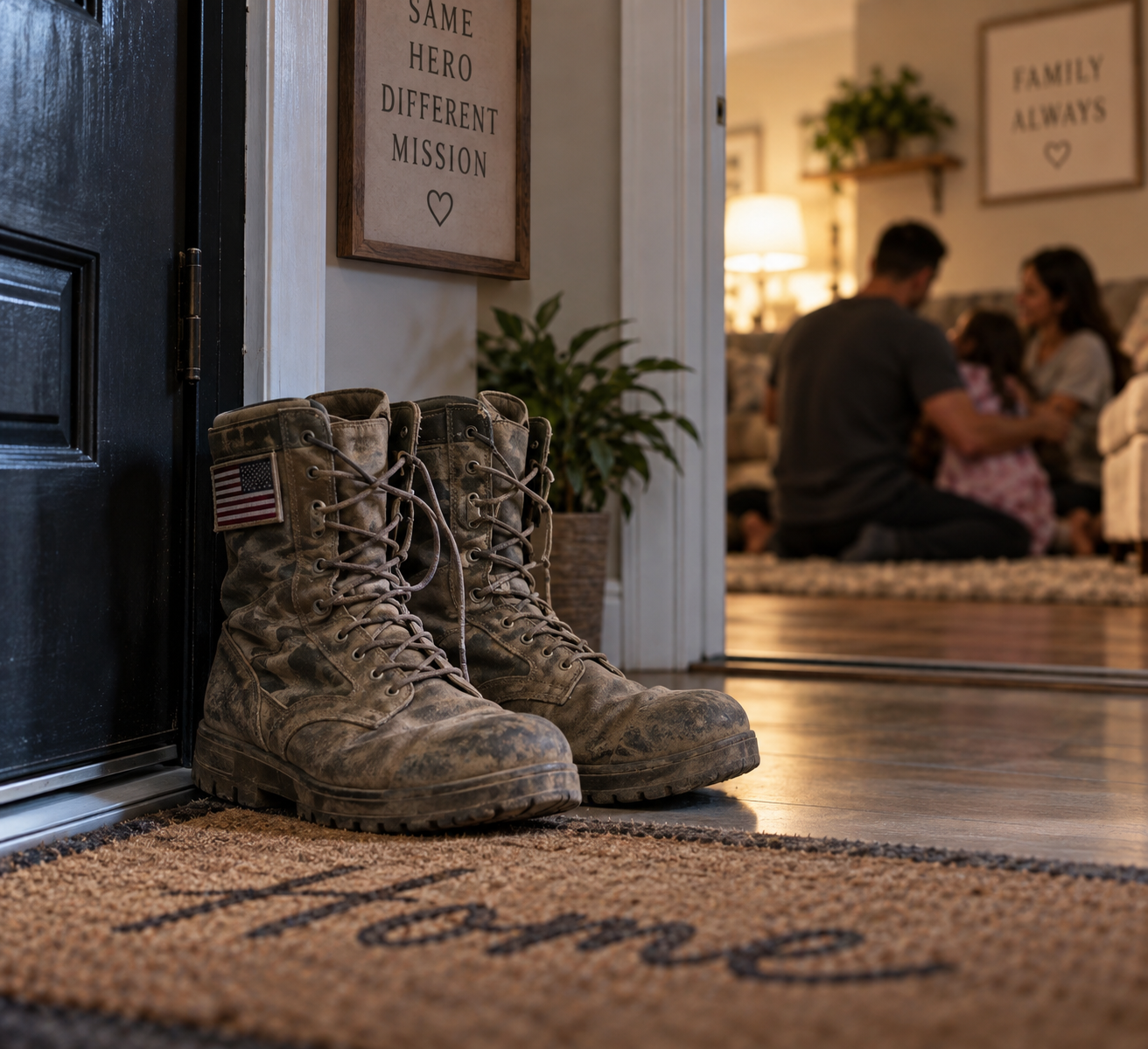
You can hold a scene together with a stranger bleeding out in front of you and your voice never moves. You have made calls under fire that other people will never have to make in their whole lives. You are, by any honest measure, good in a crisis.
Then your wife asks why you didn't answer her text and something in your chest goes hot.
You already know this doesn't add up. That's usually the part that bothers people most. Not the fight itself, but the math of it.
You didn't get worse. The mission changed.
Here is what I have come to believe after years of doing this work, and after living it at my own kitchen table as the wife of a Purple Heart combat veteran: the skills are not broken. They are pointed at the wrong target.
Threat detection, emotional control, decisive action, independence. Your career selected for those, trained them hard, and then rewarded you every time you used them. They kept you and the people around you alive. Nothing about that was a mistake.
Home is a different environment with different success criteria. The same tool that solves a problem downrange creates one in a living room, not because you are doing it wrong, but because you are doing it correctly for the wrong situation. Nobody briefed you on the change. You just came home and started failing at something you had never failed at before.
So let's go skill by skill.
1. Threat scanning
What it does at work: you walk into a room and you know the exits, who’s carrying, the guy who is off. It runs by itself. This isn’t paranoia but trained pattern recognition, and it is a large part of why you are still here.
What it does at home: it doesn't turn off, so it goes looking for a target. In an environment with no real threats, the nearest anomaly is your wife's tone of voice or your kid's silence at dinner. You end up reading a sigh as hostile intent and responding to an attack nobody launched.
Re-tasking it: the skill is noticing what other people miss. That is genuinely rare and it is enormously valuable in a relationship, if the scan is looking for something other than threat. What stress is she carrying today? What pain is underneath the silence? Same sensitivity, different collection priority.
Secondarily - maintain the threat awareness when your family is out in public. Scan, be vigilant, keep them safe. The goal is to do this from a place of steady-state awareness rather than panicky hypervigilance.
2. Emotional control
You learned to put it in a box and work the problem, and you got so good at it that the box now closes on its own before you notice it happening.
The trouble is that the box is not selective. Suppression is not a dial you can set to "block fear, allow affection." It comes down over all of it. So your wife says you're emotionally unavailable and you honestly do not know what she means, because from the inside it feels like nothing is happening at all.
What I work on with clients is not "feel more." It is control over the timing rather than a permanent setting. You already own the hardest half of that skill. Most people cannot shut it down under pressure. You can. The part we build is the part that opens it back up on purpose, in your own house, on a schedule you choose – to facilitate connection, not survival.
3. Tactical problem solving

She tells you about her day. Forty seconds in you have identified the cause, the fix, and the two people she should stop talking to. You offer it. It is a good plan. She gets angrier.
This one confuses high performers more than any other, because the solution was correct. It was just an answer to a question she never asked.
Some problems are for solving. Some are for sitting in with someone. Your career had almost none of the second kind, so you got very little practice, and the reflex to fix now fires on things that were never broken. There is a whole post's worth in this one alone, and I wrote it: "I've done harder things. Why can't I fix this?"
4. Comms discipline
Short, clear, no editorializing. On the radio it saves lives. At the dinner table it reads as a closed door.
"Fine." "It's handled." "Don't worry about it." Every one of those is a complete and accurate transmission. Every one of them also tells your family that the channel is closed and they are not on the net.
Some of this is not a habit at all. If you have held a clearance, or worked scenes you are not permitted to describe, the silence is a real professional obligation and it does not stop at your front door. That is worth saying out loud to your family, because in the absence of an explanation they will supply their own, and it is usually "he doesn't want to tell me; he is closed off; we are growing distant."
You do not have to declassify anything to say more. "Today was bad and I don't want to talk about the details, my mood isn’t about you" is fully compliant and it changes the whole night.
5. Hyper-independence
Needing nothing from anyone made you dependable. It also means that when you are struggling now, the last thing you will do is say so, and the people who love you experience that as being kept outside.
Your spouse has probably said something like "I just want to be let in." What she is asking for is not weakness. She is asking to be useful to you, the way you have been useful to everyone else for twenty years.
If you are wondering whether you are allowed to take a seat when other people have it worse: leaders eat last, sure. Good leaders also know when to eat so they can keep leading, and they model what asking for help looks like so their people will do it too.
6. Rank and role
You came up in a structure where authority was clear, roles were assigned, and everyone knew who owned the decision. It works. It is efficient.
A marriage has no chain of command, and every attempt to run one produces the same result: one of you is being managed, and neither of you likes it. Your spouse ran the household alone for months or years at a time, made every call without you, and did it well. Coming home and quietly reassuming command is the single fastest route to the fight you have been having since you got back.
The re-task here is the one you already know from any joint operation. Two competent people, different lanes, negotiated. You have done that with people you liked far less than her.
If you are reading this and recognizing yourself in four or five of these, that is not a diagnosis and it is not a character verdict. It usually just means nobody ever told you the criteria changed. A free consultation is a low-cost way to find out whether this is the work you actually need.
What this looks like when it goes well
I want to be specific about the goal, because "get in touch with your feelings" is not it and would not survive first contact with most of the people I work with.
The goal is that the skill fires when you choose it. You still scan the room. You still stay calm when the calm is needed. You still solve what needs solving. The difference is that you can also stand in your kitchen while your wife is upset and not do a single thing about it except stay there, because you decided that was the right move, and you have the tolerance to hold it. Switch your mindset and goals from “command” to “connection.”
That tolerance is trainable. It is most of what happens in the room with me. We identify what is actually getting in the way, and often it is not a skills deficit at all but something older that makes the open position feel unsafe. Some of that we talk through. Some of it we process with Accelerated Resolution Therapy, which does not require you to narrate anything you would rather not say out loud.
Depending on what you are carrying, that work might be individual work as an operator, work as a first responder, or work you do together in couples therapy. If months of weekly sessions is not realistic with your schedule, the Warrior Intensives compress it.
One more thing
Nothing in here asks you to become soft – but rather, connected. Reachable. Real. Lighter. A warrior who finds respite at home. The version of you that shows up when things go badly is worth keeping, but you and your family would like access to the rest of what’s possible as well.
You have already proven you can learn hard skill sets under pressure. This is another one. And you do not have to do it alone.
Ready to start? Schedule a free consultation. In-person in Colorado Springs, and online across PSYPACT states.
Dr. Bartel specializes in combat trauma and PTSD treatment for military service members, veterans, and their spouses and families. She provides in-person therapy in Colorado Springs and telehealth services across 42+ states.